URBAN SEGREGATION IN GOTHENBURG

Why is there such a radical and visible segregation in the city of Gothenburg?
I would like to be able to answer this research question, although I believe it will be difficult, because I will never be able to fully grasp the real effects of this issue. There are many variations and many causes happening at the same time, and surely some of them will escape me, but I will try to reach an understanding of the reasons behind it.
In Barcelona, the city where I was born, something similar happens: segregated cities, neighborhoods that share the same characteristics. There are areas where violence is more likely, more prevalent. Why do these cycles never come to an end? Is it because of a lack of opportunities, or because of an excess of opportunities on the other side? Or perhaps because of an invisible sense of belonging? If so, what would it mean to belong, or not belong, to a place? What defines the boundaries of who does or does not belong to a country? Therefore, which factors shape our identity as individuals within a shared society?
I want to analyze these questions and nuance these boundaries. But I want to do so from a literary and poetic perspective, in order to understand these situations with humanity and empathy, from a warmer and more personal experience. Because I believe that approaching this topic explicitly would make it difficult to grasp it with integrity; too many parts would slip through my fingers.
It is striking how the novels we read in childhood remain engraved in our minds in black ink. There is a book that comes back to me now, one I read when I was young and that deeply marked me: The Wall by William Sutcliffe. It tells the story of Joshua, a boy who lives in Amaria, India, a place surrounded by a great wall, guarded by strict security and soldiers. From a very young age, Joshua is told that he must never cross the wall, because it is what keeps them safe from the “enemies,” described as criminals and dangerous people.
What becomes interesting is the moment when Joshua discovers a secret tunnel that connects both sides. He crosses it, and an entirely new world opens up to him. He meets people who completely contradict his initial ideas, forcing him to question his beliefs and prejudices and to confront the truth. But most importantly, the story opens up a reflection on the debate surrounding the existence of multiple, coexisting realities.
This revelation that Joshua experiences can be compared to my own experience in Gothenburg, as it initially confirmed the image I had of Sweden as a safe, modern, and advanced country (largely because I was living in a central and privileged environment). However, this perception breaks when I attend a course in Biskopsgården and discover a reality shaped by urban abandonment, structural inequality, and long-term disinvestment, which deeply challenges my initial idea of the country.
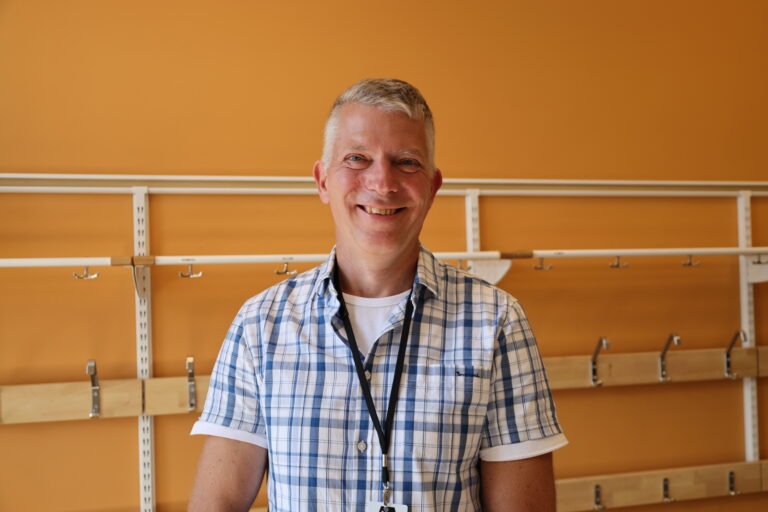
But this story is not about me; it is about José Romero.
“The political term that politicians use here in Sweden (…) vulnerable neighborhoods (…) clearly with a pejorative intention.”
“The first thing that comes to light is your stereotype, and it is widespread.”
“If you have a guest in your home, you shouldn’t leave them alone; you have to offer them the best you can within your home so they feel safe and well.”
“Sweden takes migrants and places them in Hammarkullen, Angered, Kortedala; peripheral neighborhoods classified as vulnerable.”
“So how do I make sure this person is not lazy, does not turn to drugs, does not turn to prostitution?”
“I do it by giving them work, by giving them the opportunity to improve themselves through education, to prevent these social tragedies.”
“Because if I am given that opportunity, I am also paying taxes, I am building a constructive life within society; the money I receive circulates within that same society.”
“How do you break this cycle? You have to go to the top, who are the ones who are buying?”
“We all are, and we all have the right to establish ourselves within society, and that must be valued and, above all, enriched.”
Gothenburg is the second largest city in Sweden and the one with the highest concentration of immigrant populations. In 1995, 75 percent of Swedes lived in areas with a lower presence of foreign residents. Igerud explained in 2011 that not all newcomers settle in the same areas and there is a clear hierarchy among minorities. Groups with lower social status are directed toward lower-status enclaves, while groups with higher status tend to settle in predominantly Swedish areas. Migration flows also show no indication that Swedes are moving toward areas with a higher immigrant presence; that is, as long as a certain degree of “Swedish avoidance” persists, immigrant populations will bear the full responsibility of generating greater residential mixing.
Immigrant neighborhoods that are not composed of a single ethnic group, but rather highly diverse areas where different minorities coexist. Nevertheless, within this diversity, more fine-grained patterns of clustering can be observed, as many individuals seek to live close to others from similar backgrounds. In his 2008 study, Bråmå explains that the academic literature confirms the existence of an ethnic hierarchy that influences residential patterns across the city. Urban segregation cannot be explained solely by immigrants clustering together, but also by dynamics of avoidance and out-migration among the Swedish population, which tends to relocate to more homogeneous neighborhoods. This process of “urban whitening,” or white flight, actively reinforces segregation.
Similarly, Igerud shows in his 2011 research that there is a clear ethnic hierarchy in the city: immigrants with fewer economic resources tend to concentrate in minority enclaves, while Western immigrants with greater financial capacity gain easier access to predominantly Swedish neighborhoods. However, there is no neighborhood in which a single minority exceeds 60 percent of the population or exercises clear dominance. At the same time, most Swedes do not live near non-European immigrants and do not move toward more diverse neighborhoods, displaying patterns of passive avoidance of areas with high migrant presence. As a result, urban segregation intensifies: enclaves receive new immigrants, birth rates increase, and Swedes do not mix. This process reflects dynamics of structural racism and social exclusion, which particularly affect African and Asian populations.
Ethnic segregation reflects an urban system that marginalizes certain groups by keeping them concentrated in areas with fewer resources and structurally limiting their opportunities for social mobility. For this reason, the city must be understood as a system as a whole: it is not only immigrant neighborhoods that are segregated, but the entire city. Through spatial separation and classification of people, urban space reproduces inequalities that, as Bråmå argued in 2008, constitute a serious ethical problem when they are based on ethnicity.
The political context plays a fundamental role in how segregation is perceived and interpreted. Through public and media discourse that shapes collective understanding, segregation is often associated with stigmas linked to violence, insecurity, and crime, reinforcing a negative image of neighborhoods with high migrant populations. This discursive framework not only oversimplifies a complex structural reality, but also contributes to the spread of narratives that blame specific groups for urban problems. In this way, the current political context actively shapes segregation by legitimizing dynamics of exclusion.
From my perspective, this is not about waiting for new public policies to correct segregation, nor about delegating all responsibility to the state. The focus must be placed clearly on the individual, on the citizen, and on the immense transformative power they hold to alter the status quo, by adopting a more open mindset toward others. In this sense, segregation is produced in everyday life, through daily decisions, and language plays a central role: a language imposed and reproduced by the media, governments, and political discourse, which labels certain neighborhoods as problematic and leads Swedish citizens to no longer consider them viable options when deciding where to live. This is where much of the importance of the problem lies.
Although segregation in Gothenburg has not yet reached extreme levels compared to other contexts, it has worsened, and disparities are intensifying. Precisely for this reason, now is the moment for change. If action is not taken at this stage, when inequalities are still relatively moderate, the risk is that they will become entrenched and expanded, making them far more difficult to reverse in the future. Therefore, it is now, through both individual and collective action, that we must break with the narratives and mechanisms that normalize exclusion.
References:
Igerud, M. (2011). Ethnic congregation as a segregation factor in Göteborg, Sweden: A study of residential ethnic segregation amongst affluent and poorer immigrants (Bachelor’s thesis, University of Gothenburg, Department of Human and Economic Geography). University of Gothenburg.
Bråmå, Åsa. (2008). Dynamics of ethnic residential segregation in Göteborg, Sweden, 1995–2000. Population, Space and Place. 14. 101 – 117. 10.1002/psp.479.

Reporter
Estel Gamiz Cajal,
Studio Väst